
I’m currently reading through Robert Kagan’s book “The Jungle Grows Back“. The purpose of the book is to explain the history and importance of the Liberal World Order, America’s role in it, and why America should continue investing blood and treasure in its maintenance.
In preparation for writing a series of posts on that book, I wanted to write an article talking about some core geopolitical interests of the United States. This is mostly based on stuff written by Strategic Forecasting, Inc (“Stratfor”), a geopolitical news/analysis firm. The discussion will be relevant for the upcoming posts about Kagan’s book.
The American Position
To understand America’s core interests, it’s important to understand what its position upon the global “gameboard” is. America is unusually blessed with regards to how favorable its current geographic and geopolitical situation is. The key features are as follows:
- America’s only geographic neighbors are much weaker than itself, so much so that it is almost inconceivable that they could pose a threat to it.
- America is separated from any potential economic and military competitors by two vast oceans.
- The American mainland is rich in natural resources. It contains vast hydrocarbon reserves, it has the largest contiguous mass of arable land in the world overlaid on top of a the world’s largest system of interconnected navigable waterways (the Greater Mississippi River Basin and the Intracoastal Waterway), and it has more natural harbors than the rest of the Western Hemisphere combined.
Separated from all competitors and blessed with a continent of resources to exploit, it was inevitable that America would become a Great Power. As with the modern-day Turks (who control the Dardanelles), Americans are important for where they live, independent of who they are.
The Importance of Maritime Transport
Let’s take a moment to discuss one of most important aspects of history that is rarely talked about – the importance of the oceans and of maritime transport. Maritime transport is unique in that it is orders of magnitude cheaper than any alternative form of transportation:
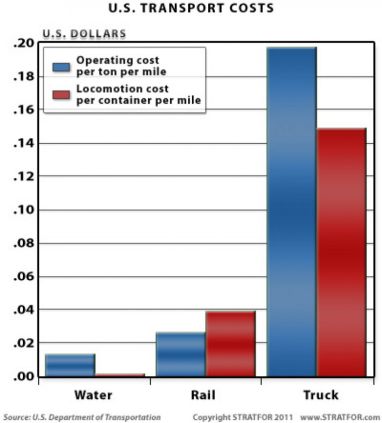
This has a number of implications. Nations with access to plentiful maritime transport options, such as the United States, are naturally capital-rich when compared to nations without them. In the American experience, this enabled individual families to move out west, start a farm, and ship their crops to anywhere in the United States via barges rather than needing government-directed investment to build roads connecting them to “civilization”. The large supply of capital and low demand for government infrastructure investment enabled the government to take relatively hands-off (laissez-faire) approach to economic management. Furthermore, the ease of long-distance transportation throughout the entire American heartland binds the nation together as one integrated community rather than the small, distinct communities that emerged in Europe.
Two Core Geopolitical Interests
Control the Seas
As Alfred Thayer Mahan discusses in his still-influential landmark book “The Influence of Sea Power Upon History” (1890), control of the seas is a key element to achieving economic and military power. Control of the seas affords the controlling nation tremendous strategic flexibility as well as diplomatic and economic clout.
Any nation that wishes to invade the American mainland must first transport their armies to the North American continent via naval vessels, so if the United States controls the oceans, it can remove any possibility of invasion. Because the United States does not have to worry about invasion of its core territory, it is free to deploy its forces far from the homeland in expeditionary deployments via its Carrier Strike Groups and Amphibious Ready Groups. This expeditionary capability enables the United States military to threaten any location on the planet with conventional forces.
Alternatively, the United States Navy is able to impose a naval blockade on any nation in the world, as the British did in the Napoleonic Wars, World War I, and World War II, bringing great economic pressure on its foes while keeping its own economy intact. Furthermore, no nation can impose a blockade of the American mainland without first defeating the United States Navy.
Given how crucially important maritime transport is to the global economy, the US Navy’s role as guarantor of freedom of navigation means the United States has vast diplomatic and economic influence.
Prevent the Rise of Regional Hegemonies
As a power of continental scope, only another nation with access to a continent-scale supply of resources and manpower can challenge the United States’ control of the oceans and thereby threaten the American mainland. Therefore, the United States has a vested interest in maintaining the global status quo and reducing aggressive territorial expansion by other nations. The United States intervened in two World Wars and the Cold War to prevent the domination of Western Europe by a single power.
The United States uses broad alliance structures to stabilize the world order. NATO serves this purpose for Western Europe and SEATO formerly served that purpose for Southeast Asia. The United States also engages in bilateral military relationships with states that have concerns about being swallowed up by an more powerful neighbor – the United Kingdom, Norway, Denmark, the Netherlands, Poland and Romania (all concerned about some combination of Germany and Russia); Pakistan (concerned about India), Taiwan (China), South Korea (North Korea, China and Japan), Mongolia (China and Russia), Thailand (China, Myanmar and Vietnam), Singapore (Malaysia and Indonesia), Indonesia (China), Australia (China and Indonesia), Georgia (Russia), the United Arab Emirates and Qatar (Saudi Arabia and Iran), Saudi Arabia (Iran), Israel (the entire Muslim world), Jordan (Israel, Syria and Iraq) and Kuwait (Iran, Iraq and Saudi Arabia).
 The Examined Life